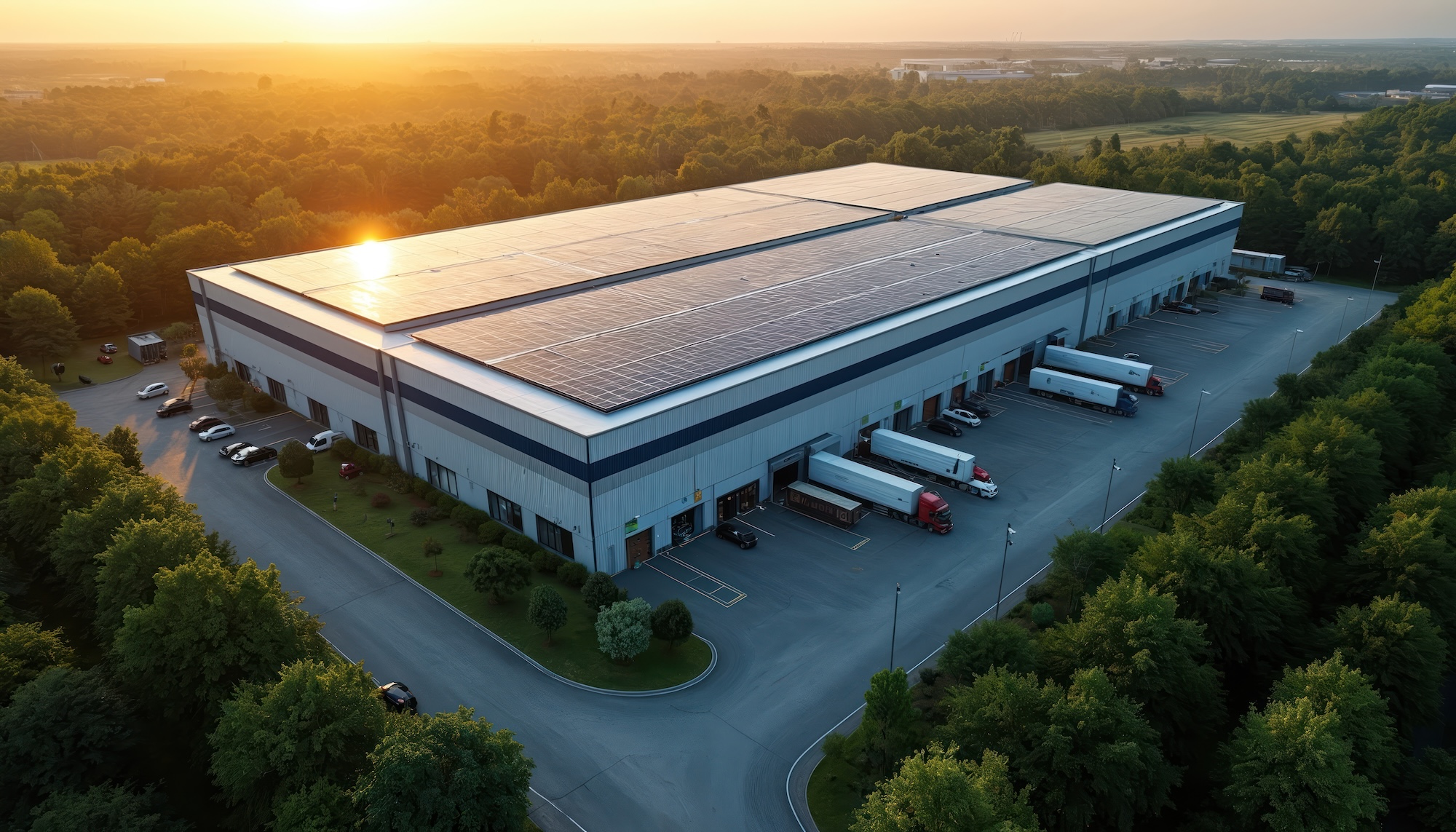
We help businesses across the UK generate their own electricity, take control of rising energy costs and build resilience against grid volatility. Every system we design is bespoke, shaped by your site, your consumption profile, your growth plans and your budget.
From a single warehouse roof to a multi site portfolio, our commercial team turns your roof space or land into a long life energy asset that pays back for decades.
High output commercial arrays for warehouse and factory roofs, offices, retail units and open land. Designed for maximum yield with minimal disruption to your operations.
Store the energy you generate and use it when it matters most. We install commercial battery systems including the Tesla Powerwall 3, helping you cut peak charges and keep critical operations running.
Smart charging for staff, fleet and customer vehicles, integrated with your solar generation so more of your miles run on your own clean power.
We combine deep technical engineering with a clear grasp of the numbers that matter to your business.
Accredited and certified
What makes commercial solar work is not the panel. It is how closely generation lines up with what the building already uses during daylight, and that differs completely by sector.
Large unshaded roofs and a load that runs through the working day. Usually the best case in commercial solar, because most of what the roof makes is used on site rather than exported for pence.
Barn roofs, ground mounts and three phase supplies, often with a grid connection that needs checking before anything is designed. Our farms page covers this in detail.
Daytime occupancy that matches generation almost exactly, but a procurement route that is nothing like a private sale. We have written about how public sector solar actually gets bought.
Smaller roofs, but a load profile weighted to the working day and often significant refrigeration or air conditioning, which is exactly when the sun is out.
Solar across a stock of homes, usually alongside insulation and heating under a wider retrofit programme. That work runs through our sub contracting side.
One survey approach applied across every site, so the business gets a comparable set of numbers and can decide which roofs are worth doing first rather than doing all of them at once.
We do not put a price on a building we have not surveyed. What we can do is show the shape of it, using figures that have been published by other people rather than produced by us.
What a 100 kWp array on a large unshaded roof typically generates in a year. Whether that is worth 7p or 26p a unit depends entirely on how much of it you use on site rather than export.
Cheltenham Town fitted 213 panels in 2023 for around £90,000 and report saving about £21,000 a year. Their figures, not ours, and their roof is not yours, but it shows the order of magnitude.
Preston North End’s installation at Deepdale, the largest in the EFL, was funded entirely by a third party and is reported to have saved the club that much in its first year without capital outlay.
Figures published by Cheltenham Town, Cotswold Energy and reporting on Preston North End. They are other people’s projects, included to show the scale rather than to predict yours. Your own figures come from a survey of your roof and your half hourly consumption data.
You own the asset and every kilowatt hour it makes, and the return sits with you. The simplest arrangement, and the one that returns most over twenty five years if the capital is available.
Somebody else pays for the system and you buy the electricity it produces, usually below grid rate. No capital outlay. This is the model that paid for Deepdale, and it suits organisations with roof space but no budget line.
You rent the roof space and take a smaller benefit without touching the electricity arrangement at all. Rarely the best return, but occasionally the only route that fits.
Energy Giants does not lend and is not authorised to advise on finance. We design and install, and we will set out plainly which of these routes a scheme of your size normally takes so you can take that to your own advisers.
On a domestic roof the network notification is paperwork. On a commercial site it can decide whether the scheme happens at all, which is why we look at it first rather than last.
Before anything is designed we want a year of your half hourly consumption. It tells us what the building uses and when, which is what sizes the array. A design without it is guesswork.
The roof itself: orientation, pitch, covering, age, fixings and whether the structure will carry it. On older industrial roofs this is often the constraint, not the space.
Anything above the G98 threshold is a G99 application to your network operator, and the answer can come back limited. We make that application and design around the answer, including export limitation where it is needed.
Our own crews, with the site kept running. Then the certificates, the network sign off and the monitoring set up so you can see what the roof is doing.
There is no minimum that makes sense as a rule, because what matters is your electricity use rather than your roof area. As a rough guide, 100 kWp needs somewhere around 500 square metres of usable roof. We have designed schemes on small industrial units and on barns of several thousand square metres.
Usually, but it is checked rather than assumed. A modern portal frame building is rarely a problem. Older roofs, and anything with a history of repairs, get a structural opinion before we design a layout. If the answer is no we tell you before you have spent anything.
It is the application to your district network operator for permission to connect generation above the small scale threshold. Timescales vary by operator and by how much spare capacity sits on your part of the network. It can come back approved, approved with an export limit, or refused pending reinforcement, and we design around whichever answer arrives.
No. Commercial installations are sequenced around your operation, roof section by roof section, and the electrical connection work is planned for whatever window suits you. We will tell you honestly which parts need an outage and how long it needs to be.
Sometimes, and rather less often than it is sold. A battery earns its place where you have significant demand outside daylight hours, high peak charges, or a genuine need for resilience. If your load sits squarely in the working day, the panels alone may be the better investment.
It is exported, and what you get for it depends on your supply contract rather than on the panels. Export is almost always worth far less than the electricity you avoid buying, which is why the design targets on site use first.
No. The survey, the design, the installation and the commissioning are done by our own employed crews, and the people who quoted the job are the people who hand it over.
Yes. We survey each site on the same basis so the figures are comparable, then set out which roofs are worth doing and in what order. Most portfolios have two or three sites that pay back considerably faster than the rest.
A school does not ring three installers. The frameworks, the funding routes, and the three technical questions to settle before anyone designs anything.
The EFL grades its clubs on sustainability. But the interesting story is financial: one Lancashire club has just taken £84,000 a year off its running costs.
Lancaster City Council has approved a solar canopy, a battery and eight rapid chargers on the Auction Mart car park. We're not involved, but the design decisions in the planning file are worth learning from, at home and at work.
Tell us about your site and requirements and a member of our commercial team will be in touch to discuss the opportunity, with no obligation.
01200 407790