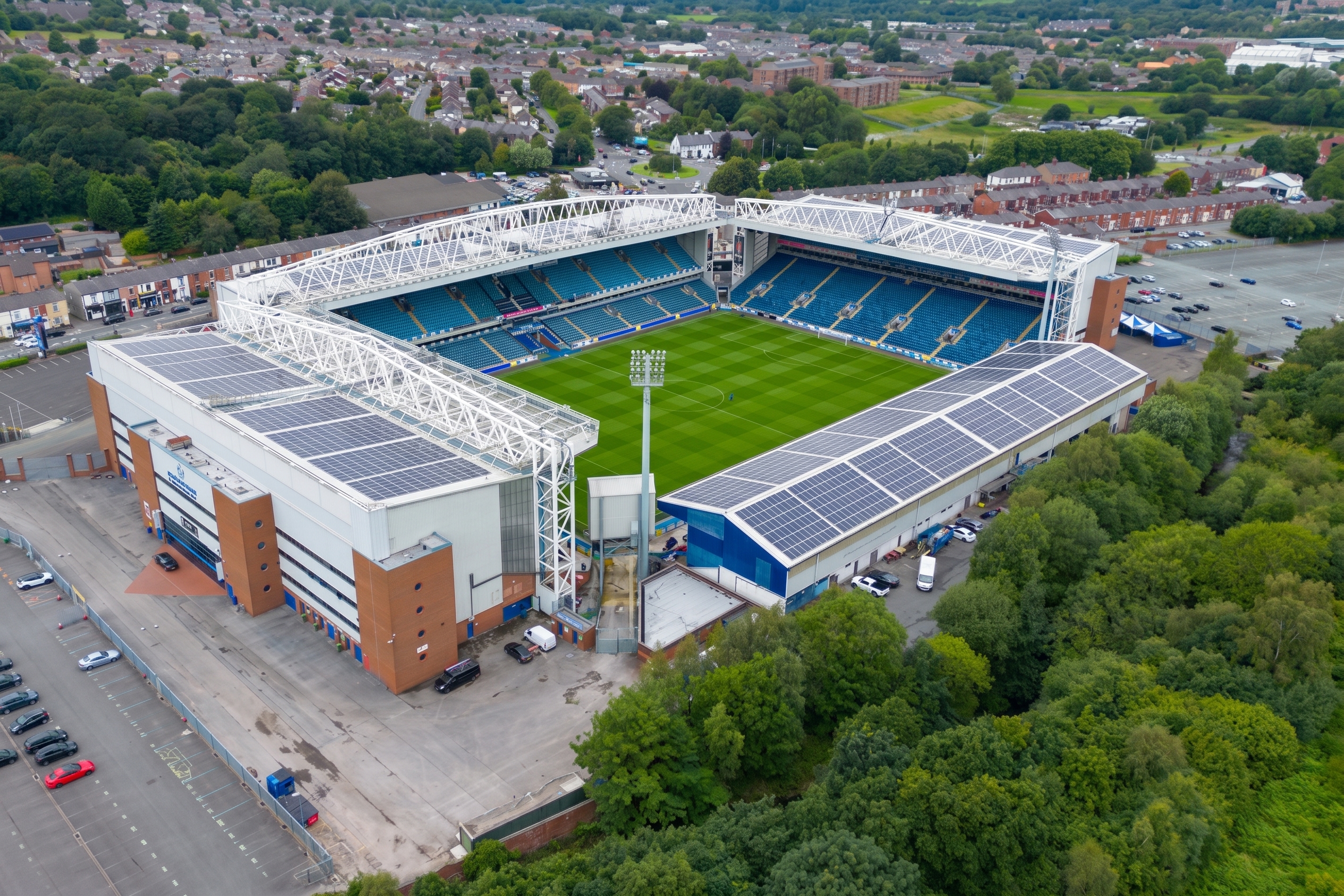

The season is under way, and there is a second table nobody prints in the matchday programme. This one is about what happens to a stadium on the other six days of the week.
The EFL runs a scheme called Green Clubs. It launched in 2021, was rebuilt for the 2024/25 season, and it now hands out graded awards to clubs that can prove what they are doing rather than just say it. Assessments are verified by a third party auditor, which is more than most sustainability badges in any industry can claim.
We fit solar panels on houses in Lancashire for a living, so we came at this looking for one specific thing: which clubs have actually put panels on the roof.
The answer surprised us, and the biggest single project in the English Football League is a twenty minute drive from our HQ in Clitheroe.
How the scheme works
Green Clubs is voluntary and delivered with GreenCode, the accreditation body run by the Green Britain Group. Clubs opt in, go through a development season where they set a baseline and publish an environmental policy, then get assessed.
Four grades. Gold requires a score of 76 or more.
The Championship, 2026-27, club by club
Updated 14 September 2026. With three clubs up from League One, three down from the Premier League and Coventry, Ipswich and Hull promoted, this is the division as it stands, with what the EFL has announced about each club and whether there are panels on the ground. This table puts panels first: the three grounds generating their own electricity sit at the top, in order of published output, then the two with schemes planned, then everyone else by Green Clubs status. Read that way the leaders are West Ham, whose panels belong to the London Stadium rather than the club, and Preston, and neither holds a Green Clubs award. Nine of the twenty four do, and Swansea are a Participant.
| # | Club | Green Clubs | Solar on site | What we know |
|---|---|---|---|---|
| 1 | West Ham United London Stadium | Not announced | Yes | Relegated from the Premier League. Solar is on the stadium, not owned by the club: 6,500 m² of lightweight solar membrane on the London Stadium roof, delivered by Ameresco and switched on in July 2025, about 850,000 kWh a year, funded through the Mayor of London’s Green Finance Fund. |
| 2 | Preston North End Deepdale | Not announced | Yes | The largest solar project in the EFL: 780 panels on the West, East and South stand roofs, applied for in March 2025 through Saber Renewable Energy with an estimated 278,000 kWh a year, commissioned spring 2026, third party funded, £84,000 saved in year one. |
| 3 | Bristol City Ashton Gate | Gold | Yes | 460 panels across the Bristol Sport group; no annual output published. Gold since March 2025, GreenCode status since 2023. |
| 4 | Blackburn Rovers Ewood Park | Silver | Planned | Silver in May 2025. Published energy and environmental policies; stand roofs assessed for solar with storage, not yet built. |
| 5 | Portsmouth Fratton Park | Silver | Planned | Silver in July 2025. Partnership with the city council that has prioritised solar; local, plant based food options. |
| 6 | Charlton Athletic The Valley | Silver | Not reported | Silver in August 2025. A Green Team drives sustainability across the club, with partners including the RSK Group and the University of Greenwich. |
| 7 | Millwall The Den | Silver | Not reported | Silver in May 2025. Signed up to the UN Sports for Climate Action framework; Lion Living campaign promotes sustainable habits in and out of the club. |
| 8 | West Bromwich Albion The Hawthorns | Silver | Not reported | Staff working group, Baggies Pastures Green; purchasing waste cut first. |
| 9 | Derby County Pride Park | Bronze | Not reported | Bronze in July 2025. Sustainable travel plan with the council, reusable cups, surplus food to a food bank. |
| 10 | Lincoln City Sincil Bank | Bronze | Not reported | Bronze in July 2025. Fan sustainability challenges with Quambio, greener travel. |
| 11 | Middlesbrough Riverside Stadium | Bronze | Not reported | Bronze in June 2025. Reuse across the Riverside, training ground allotments, rewilding. |
| 12 | Swansea City Swansea.com Stadium | Participant | Not reported | Participant status in August 2025, the scheme’s newest member. “One Planet, One Chance” reusable cup system launched for matchdays. |
| 13 | Birmingham City St Andrew's | Not announced | Not reported | |
| 14 | Bolton Wanderers Toughsheet Community Stadium | Not announced | Not reported | Promoted from League One. |
| 15 | Burnley Turf Moor | Not announced | Not reported | Relegated from the Premier League, where the Environmental Sustainability Commitment set a minimum standard. |
| 16 | Cardiff City Cardiff City Stadium | Not announced | Not reported | Promoted from League One. |
| 17 | Norwich City Carrow Road | Not announced | Not reported | |
| 18 | Queens Park Rangers Loftus Road | Not announced | Not reported | |
| 19 | Sheffield United Bramall Lane | Not announced | Not reported | |
| 20 | Southampton St Mary’s Stadium | Not announced | Not reported | |
| 21 | Stoke City bet365 Stadium | Not announced | Not reported | |
| 22 | Watford Vicarage Road | Not announced | Not reported | |
| 23 | Wolverhampton Wanderers Molineux | Not announced | Not reported | Relegated from the Premier League. |
| 24 | Wrexham Racecourse Ground | Not announced | Not reported |
Ordered by solar on site (generating, then planned, then none reported), with generating grounds ranked by published annual output; within each group by Green Clubs status, then alphabetically. Status is as announced by the EFL or the club; “Not announced” means no public award, which may mean the club is not in the scheme or has not yet completed the cycle. “Not reported” means we found no public record of a rooftop array. Compiled 14 September 2026 from the EFL Green Clubs announcements of March, May, June, July and August 2025, club statements and press reports. The EFL treated 2025-26 as a development season, with training open to all 72 clubs, and says the next assessments will be published across its channels during 2026-27, so expect this table to change.
What the grades mean
Green Clubs is voluntary and assessed by GreenCode, part of the Green Britain Group. Bronze needs a verified score of 30 or more, a named board member responsible for sustainability, a published environmental policy and baseline carbon data for Scopes 1 and 2. Silver needs 50 or more, targets, evidence that sustainability shapes procurement, and a footprint covering every SECR category. Gold needs 76 or more from an external audit, a Scope 3 footprint including waste, water and commuting, and a net zero target. Solar does not appear in the criteria by name, but it moves the numbers on energy and on Scope 2.
For a points based comparison, the last one published for the division is the Sport Positive Leagues Championship matrix for 2022, scored out of 24 across eleven categories including clean energy. Bristol City topped it on 22, ahead of Norwich City on 19.5 and Watford on 19. Blackburn Rovers, Middlesbrough and Swansea City did not take part that year; all three now hold a Green Clubs status.
Awards across all three divisions
This is ordered by published award status, not by a score of our own. Where clubs share a grade they are listed alphabetically, because the EFL does not publish the underlying numbers and we are not going to invent a ranking.
| Club | Status | Solar on site | Known for |
|---|---|---|---|
| Bristol City | Gold | Yes, 460 panels | Project Whitebeam across the whole Bristol Sport group. Held GreenCode status from 2023, before the refreshed scheme existed. |
| Plymouth Argyle | Gold | Yes, 229 panels | Energy and Environmental Plan since 2022. Targeting net zero by 2050. No gambling sponsors as a matter of policy. |
| Blackburn Rovers | Silver | Planned | Silver in May 2025. Schools eco-conference nominated at the EFL Awards; suppliers engaged on the local environment; stand roofs assessed for solar with storage. |
| Bradford City | Silver | Not reported | Silver in July 2025. Greener Bantams action plan: kits from sustainable materials, community kit donation and reuse. |
| Charlton Athletic | Silver | Not reported | Silver in August 2025. A Green Team drives sustainability across the club, with partners including the RSK Group and the University of Greenwich. |
| Exeter City | Silver | Not reported | Eighteen months of work on operations, plus a push to document what was already happening. |
| Huddersfield Town | Silver | Not reported | Silver in August 2025. Carbon literacy training for staff and a supporters’ sustainability focus group. |
| Leyton Orient | Silver | Not reported | Silver in July 2025. Partnership with Ampergia since 2024 bringing green energy measures across the club’s facilities. |
| Millwall | Silver | Not reported | Silver in May 2025. Signed up to the UN Sports for Climate Action framework; Lion Living campaign. |
| Portsmouth | Silver | Planned | Silver in July 2025. City council partnership that has prioritised solar; local suppliers for plant based food. |
| West Bromwich Albion | Silver | Not reported | Staff working group, Baggies Pastures Green. First initiative was cutting purchasing waste. |
| Wycombe Wanderers | Silver | Not reported | Silver in August 2025. Matchday shuttle bus, on-site EV chargers and recyclable catering. |
| Carlisle United | Bronze | Not reported | Rewilding partnership with Cumbria Wildlife Trust and the university. Their chairman has said flood insurance is becoming unaffordable. |
| Derby County | Bronze | Not reported | Bronze in July 2025. Sustainable travel plan with the council, reusable cups, surplus food to a food bank. |
| Doncaster Rovers | Bronze | Not reported | Bronze in July 2025. Recycles more than 90% of waste; First Bus partnership for greener travel to the Eco-Power Stadium. |
| Grimsby Town | Bronze | Not reported | Bronze in August 2025. Applying for B Corp status. |
| Leeds United | Bronze | Not reported | Local sourcing on matchday menus and a herb garden supplying the player canteen. |
| Lincoln City | Bronze | Not reported | Bronze in July 2025. Fan sustainability challenges with Quambio, focused on greener travel. |
| Middlesbrough | Bronze | Not reported | Reuse across the Riverside: repurposed tables, bars and fan zone counters. Training ground allotments. |
| Northampton Town | Bronze | Not reported | Won an EFL Award for Cobblers Tackle Food Waste. Work with the Hedgehog Preservation Society. EV charging on site. |
| Peterborough United | Bronze | Not reported | Bronze in May 2025. Composting and wildflower planting at the club’s facilities. |
| Bristol Rovers | Participant | Not reported | Participant in May 2025. Plastic waste reduction and green spaces for biodiversity. |
| Rotherham United | Participant | Not reported | First League One club to complete the assessment. |
| Swansea City | Participant | Not reported | Participant in August 2025, the scheme’s newest member. “One Planet, One Chance” reusable cups. |
| Tranmere Rovers | Participant | Not reported | LED pitch lighting, EV charging points and cycle racks. Water and energy measures across the ground. |
Compiled from EFL and club announcements up to August 2025, the last batch before the EFL’s 2025-26 development season. More than 30 of the 72 EFL clubs are signed up to the scheme (the EFL put it at 36 in May 2025), so this lists those whose awards have been publicly announced rather than every participant. “Not reported” means we found no public record of a rooftop array, not that there definitely is not one.
Our commercial team designs, installs and maintains solar and storage for businesses, public bodies and housing providers, and will tell you honestly whether a site stacks up.
Now the bit we came for
Three grounds with panels on the roof, and the numbers behind them are genuinely interesting.
Preston North End, Deepdale: built, running, and it cost the club nothing
A planning application went in during March 2025 for solar across the west, east and south stand roofs. What has actually been delivered is a 120 kW solar array paired with a 180 kW combined heat and power engine, installed from January 2026 and fully commissioned by that spring.
Between them the two systems generate around 1,208,532 kWh a year against a stadium consumption of 1,540,587 kWh. That is up to 80 per cent of everything Deepdale uses, produced on site.
The solar is the smaller half of that, and we are not going to pretend otherwise. A 120 kW array in Lancashire produces somewhere around a tenth of that total, with the CHP engine doing the heavy lifting. The engine is also hydrogen ready, so it can change fuel later rather than locking the club into a technology that may not last the term.
Bristol City, Ashton Gate: 460 panels, and a seven day install
Fitted in 2016 during the redevelopment of the West Stand, as a joint effort between Bristol City Council and the stadium owner. The array is 460 panels rated at 255W each, and it generates over 96 MWh a year with essentially all of it used on site rather than exported.
At the time it was forecast to cut the stadium's carbon emissions by around a fifth and save roughly £150,000 in energy costs over twenty years.
The detail we like: a team of four fitted the lot in seven days, working around a stadium redevelopment that had to be finished before the season kicked off. That is a serious bit of programming on a live site.
Plymouth Argyle: 229 panels, and players charging cars off the grandstand
The refurbished grandstand at Home Park was built with efficiency designed in rather than bolted on afterwards: LED lighting, rainwater harvesting, and 229 panels on the roof reported as powering the stadium.
The bit that made us smile is that players at the club have switched to electric cars and charge them cheaply at the ground off the grandstand solar. That is exactly how it is supposed to work. Generate it, use it where it is made, do not send it back to the grid for a fraction of what it is worth.
Forest Green Rovers: the club that started it
Panels went on The New Lawn back in 2011, when this was a genuinely odd thing for a football club to do. The array covers a useful share of the stadium's electricity, and the club runs on renewable supply on top of that.
Worth knowing, because it explains the whole scheme: GreenCode, the body that assesses EFL clubs for Green Clubs status, was founded by Forest Green's chairman Dale Vince. One club's obsession became the league's standard.
The panels were reportedly Gary Neville's idea. Football is a small world.
And the biggest project in the league just arrived
West Ham United came down from the Premier League at the end of last season, and they brought something with them that no other club in the division has.
The technical choice is the interesting part. A stadium roof that size cannot take the weight of conventional framed panels, so the installation uses ultra lightweight thin film membrane bonded into the roof instead. Different technology to anything that goes on a house, solving a problem a house does not have.
Combined with LED lighting and other efficiency work, the venue expects to cut grid consumption from around 12 million kWh in 2022 to about 8.5 million by this year. That is three and a half million units a year no longer being bought.
Relegation costs a club a fortune. Parachute payments soften it, but every line of the budget gets looked at. Arriving in the Championship having already taken several million pounds a year off your running costs is not a bad position to be in, and it is worth noting that West Ham did the work while they were still in the Premier League rather than after the drop.
Which is the pattern worth spotting. The efficiency work that helps most is the work done before you need it.
The Deepdale numbers, and what they actually buy you
This is the part worth reading twice.
Preston had two problems that will sound familiar at any ground. Energy costs going one way, and a diesel backup generator at the end of its working life. Replacing that generator was a bill with no upside.
What they have instead is a system generating around 1,208,532 kWh a year against a stadium consumption of 1,540,587. Four fifths of everything Deepdale uses, made on the premises. The club put in no capital, carries no maintenance responsibility, and owns the equipment outright at the end of the term.
Now think about what £84,000 a year is in football terms
Here is where this stops being a sustainability story and starts being a football one.
A saving on the electricity bill is not like other money. It is not gate receipts, which depend on how the team is playing. It is not prize money, which depends on where you finish. It is not a transfer fee, which depends on somebody else's chairman picking up the phone.
It is money that arrives every year whether you win on Saturday or not, and it goes straight to the bottom line.
Eighty four thousand pounds a year is a meaningful number in the EFL. In League One and League Two it is genuinely significant, the sort of figure that decides whether you can keep a player on a new contract, take a loan deal with a wage contribution, or fund an academy role you have been putting off. In the Championship it is smaller relative to the wage bill, but it is still a permanent saving with no performance risk attached.
Over fifteen years, a projected £1.56m is squad money. Not headline signing money, but the kind of steady margin that lets a club say yes to things it otherwise cannot.
There is a second effect that matters more than the first. Clubs across the EFL now operate under spending controls tied to turnover and costs. Cutting a large fixed operating cost does not just free up cash, it improves the ratio that governs what you are allowed to spend in the first place. A ground that runs cheaper is a club with more room to work with.
The competitive edge nobody is talking about
Two clubs in the same division, similar turnover, similar crowds. One pays full whack for every unit of electricity that lights the ground, heats the offices and runs the floodlights. The other generates most of its own.
That gap does not show up in the league table. It shows up in the accounts, and then it shows up in the league table about three seasons later.
Because the club with the lower running cost can absorb a bad season better. It can hold its nerve in January rather than selling. It can match a wage offer that the other club has to walk away from. None of that is dramatic and none of it makes the back pages. It just quietly compounds.
Football has always understood marginal gains on the pitch. Sports science, recruitment analytics, set piece coaches. Very few clubs have applied the same thinking to the building the whole operation runs out of, which is odd, because the building is one of the largest fixed costs on the balance sheet and one of the few a club fully controls.
The clubs that work this out early will have an advantage over the ones that do not. It will be an unglamorous advantage and nobody will write a song about it, but it will be real.
The Lancashire picture is better than the award table suggests
Here is where it gets interesting, and where we had to correct our own assumption.
Only one Lancashire club, Blackburn Rovers, appears in the published Green Clubs award announcements, with Silver in May 2025. Blackburn Rovers, Preston North End, Blackpool, Fleetwood Town, Morecambe, Accrington Stanley, Bolton Wanderers, Wigan Athletic. None of them.
You could read that as the county lagging behind. Look at what the clubs are actually doing and the opposite is closer to the truth.
Blackburn have gone further than the paperwork. A case study published by an energy consultancy sets out a package assessed for Ewood Park covering ground source heating and air management, an on site borehole for pitch irrigation, and real time utilities monitoring. It identifies the large angled roofs of two of the stands as suitable for solar PV which, with battery storage, it describes as capable of covering the club's electricity. That is a plan rather than a completed installation, and we would not present it as anything else, but it is a serious piece of thinking about a 30,000 seat ground. Energy Giants is an Associate Partner of Blackburn Rovers FC for the 2026-27 season, so this is a plan we follow with more than professional interest.
So the honest summary is not that Lancashire is behind. It is that Lancashire clubs are doing the work and not entering the scheme that would get them credit for it.
Which is a shame twice over. The assessment is voluntary and free to enter, and the clubs at the top of that table are not the wealthy ones: Exeter City is fan owned, Northampton Town and Carlisle United are not awash with money, and Forest Green built the entire template from the fourth tier.
A note to the rest of the North West
Blackpool, Fleetwood Town, Morecambe, Accrington Stanley, Bolton Wanderers, Wigan Athletic, Oldham Athletic, Salford City, Stockport County, Tranmere Rovers, Crewe Alexandra, Barrow, Carlisle United.
Between you there is an enormous amount of south facing steel sitting over car parks and stands, doing nothing for most of the week.
The Preston project matters to all of you for one reason: it proves the money objection is soluble. A club with a hundred and fifty year old ground and a dying diesel generator ended up with 80 per cent of its electricity generated on site, £84,000 back in the first year, and nothing paid up front. Every part of that is available at a smaller scale on a smaller roof.
And there is a competitive point here that ought to concentrate a few minds. Preston have just taken a large fixed cost out of their budget permanently. Their rivals in that division have not. That is not a sustainability advantage, it is a financial one, and financial advantages in football tend to show up on the pitch eventually.
And the ground work is worth doing even if the answer turns out to be no. A roof survey, a demand profile and a documented energy plan are exactly the evidence the Green Clubs assessment asks for. You would be building the sustainability case and the business case with the same piece of work.
We would genuinely like to see a North West club at the top of that table. There is no reason it should be a two horse race between Bristol and Plymouth.
But more than that, we would like to see local clubs stop treating the energy bill as a fixed cost of existing. It is not. It is one of the few large numbers on the balance sheet that a club can actually do something about, and every season it goes unexamined is money that could have been spent on the team.
Why a stand roof is a good solar proposition
Setting the awards aside, football grounds are genuinely well suited to this, often better suited than the houses around them.
The catch is structural. Stand roofs are engineered for wind uplift and their own weight, not for an added array, and the older ones were designed before anybody was thinking about it. That is why London Stadium used bonded thin film membrane rather than framed panels. It is a survey question before it is a solar question, and it is the first thing anyone competent will ask about.
What a fan can take from this
Two things, honestly.
The first is that the numbers at a stadium are the same numbers at a house, just with more zeros. Ashton Gate uses essentially all of its generation on site rather than exporting it, because a building that is busy in the daytime gets far more value from solar than one that is empty. Plymouth's players charging cars off the grandstand is the same principle. That is the single most important thing to understand about solar at any scale, and a football club demonstrates it better than any brochure.
The second is that this is not really about the environment any more, or not only about it. A club generating most of its own electricity has a permanently lower cost base than the club it is competing against for a signature in January. Ask what grade your club holds, by all means. But the better question at a fans forum is what the ground costs to run, and what anybody is doing about it.
The new season is a few weeks old. There is a long way to go in both tables.
If you work at a club, ground or venue
We install solar and battery storage across Lancashire and the North West, and stand roofs are a job we would very much like more of.
This is not a pitch for a contract. It is an offer of a first conversation, because the honest position is that most clubs have no idea whether their roofs are viable, and finding out costs nothing.
If the Deepdale project has made you wonder about your own ground, that first question is the same regardless of who eventually does the work or who pays for it: what would the roofs actually carry, and how much of it would you use yourself.
Same offer to anyone running a non league ground, a training complex, a leisure centre or a community sports club. The roof is smaller, the arithmetic is identical, and the daytime demand argument often works even better.
What is the EFL Green Clubs scheme?
A voluntary sustainability accreditation run by the English Football League with GreenCode, the accreditation body of the Green Britain Group. Clubs set a baseline, publish an environmental policy and are assessed by a third party auditor into Participant, Bronze, Silver or Gold, with Gold needing a score of 76 or more.
Which EFL clubs have solar panels?
Of the clubs with published award status, Bristol City (460 panels at Ashton Gate), Plymouth Argyle (229) and Forest Green Rovers (170) have reported arrays. The largest project in the league is Preston North End’s Deepdale, commissioned in spring 2026 and generating around 80 per cent of the ground’s electricity, though Preston holds no Green Clubs award.
How much can stadium solar save?
Deepdale’s installation is reported to save £84,000 in its first year. The figure depends on the roof area, how much of the club’s use happens in daylight on non match days, and whether a battery carries generation into evening kick offs.
Can a club get solar with no upfront cost?
Preston’s project was funded entirely by a third party, with the club paying for the electricity rather than the panels. Power purchase and roof lease models exist for grounds, venues and other large roofs; the roof has to be sound and the club’s daytime demand has to justify it.
Does Energy Giants install solar on stadiums and commercial roofs?
Yes. We design and install commercial solar and battery systems, from stand roofs to warehouses and public buildings, alongside our domestic work in Lancashire and the North West. See our commercial solar page.
Miles has spent two decades in retrofit and has worked at scale across the UK, with long-standing relationships with local authorities including Kirklees Council, Durham County Council and Ribble Valley Borough Council. He has project-directed programmes for housing associations and delivery partners including Aspire Housing, Sureserve, LivGreen and BroadOak, and for energy suppliers including E.ON Next, Utilita, British Gas, Octopus and UKEM.