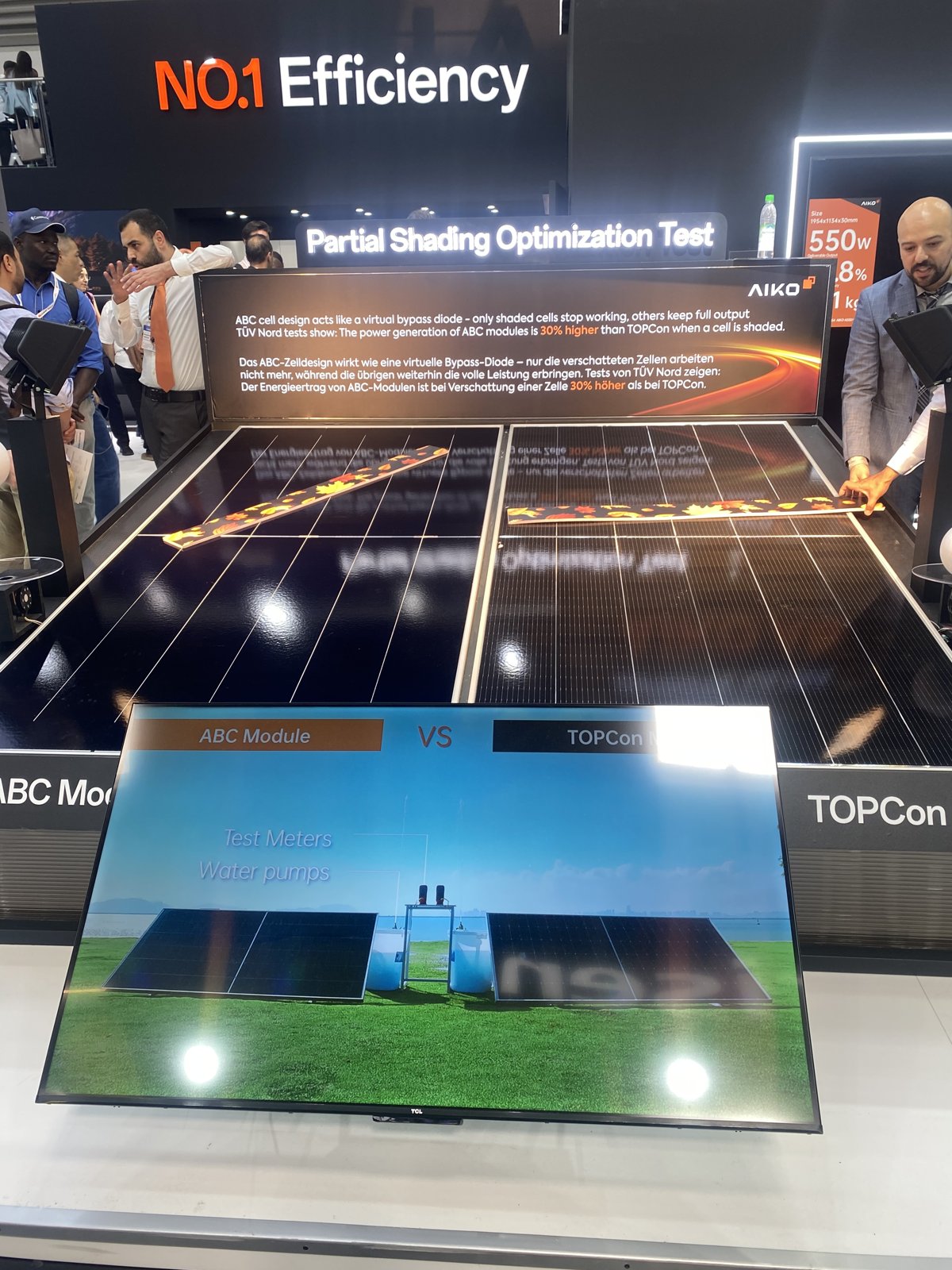
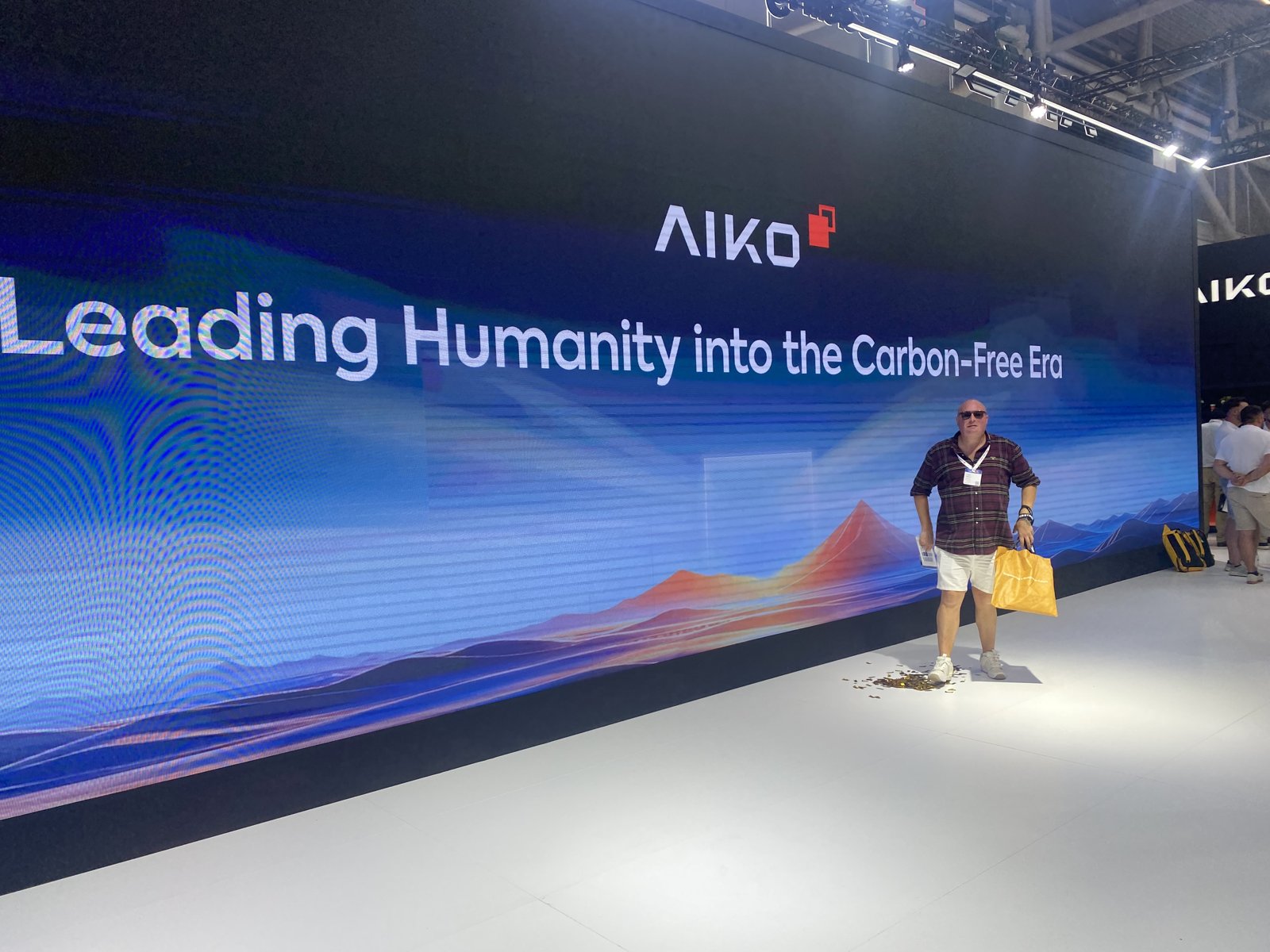
Our team spent a day with Aiko at Intersolar Europe in Munich this summer: on their stand, with their UK business development team, in front of the live shading test and the new residential range, asking the awkward questions installers ask. We came back with the photos in this post, a closer working relationship with the people who make the panels we fit, and a clearer answer to the question we get asked more than any other about solar on a shaded roof: do I need optimisers?
The short version: optimisers solve a real problem, most roofs in Lancashire have a bit of that problem, and Aiko has moved the fix out of a box on the roof and into the cell itself. That is why we install Aiko, and it is why the answer for most of our customers is now no. The long version is below.

Why a small shadow is a big problem
A solar panel is a chain of cells wired in series, and a series chain is only as strong as its weakest link. Shade one cell with a chimney, a leaf or a satellite dish and it cannot pass the current the others are producing. Left alone it would heat up and eventually damage itself, so every conventional panel is fitted with bypass diodes, usually three, each guarding a third of the panel. When a cell is shaded the diode does its job: it switches that whole third off. One shaded cell, a third of the panel gone.
It gets worse, because panels are also wired in series with each other to form a string. A string inverter looks for the one voltage and current that gets the most out of the whole string, and a panel that has lost a third drags every panel on that string down towards its level. On a terrace with a chimney every two houses, or a semi with a neighbour’s tree to the south west, that is a daily event, not a rare one.
What an optimiser actually is
An optimiser is a small DC to DC converter bolted to the back of each panel. It does one thing well: it lets each panel find its own best operating point, then converts the result so the string inverter sees a well behaved string whatever is happening panel by panel. A shaded panel still loses its shaded third, but it no longer pulls the others down with it. Most optimisers also report each panel’s output to an app, and most can shut a panel down to a safe voltage on command, which is useful on commercial roofs and for firefighters.
Microinverters take the same idea a step further and put a complete inverter under each panel, so every panel runs on its own. Both are what the industry calls module level power electronics. Both work. Both put more electronics on the roof, in the sun and the rain, for twenty five years, and both cost money per panel.
How the same shadow plays out on a conventional panel, a conventional panel with an optimiser, and an Aiko ABC panel. Simplified: real panels have more cells, but the principle is exactly this.
We survey every roof in person, from our HQ in Clitheroe and our Manchester and London offices, and tell you honestly whether it is worth doing.
When you need them, and when you are paying for nothing
This is the part that gets skipped by anyone selling optimisers as standard. They earn their keep in four situations:
- Panels facing three or more directions on one inverter. A string wants every panel doing the same thing. Two roof faces are fine on the twin tracker inverters we fit; three or more are not, and optimisers (or a second inverter) solve it.
- Heavy, moving shade across many panels. A large tree that sweeps a shadow over half the array through the afternoon, rather than a chimney that clips one panel.
- A requirement for panel level monitoring or shutdown. Common on commercial and public sector roofs, rare on a house.
- Mixing panels of different sizes or ages on one string, for example when extending a system.
On an unshaded roof facing one way, or two ways on a two tracker inverter, they add cost, a failure point per panel and nothing you will ever see in the numbers. We say so on the survey, and we would rather lose the upsell than fit kit you do not need.
What Aiko does differently
Aiko’s residential panels use a cell design called ABC, all back contact. On an ordinary cell the metal fingers and busbars that collect the current sit on the front, in the light, and every millimetre of metal is a millimetre of silicon that cannot see the sun. On an ABC cell all of the contacts are on the back. The front is uninterrupted silicon, which is a large part of why the efficiencies on the stand start where most of the market finishes.
Shade, handled in the cell rather than in a box
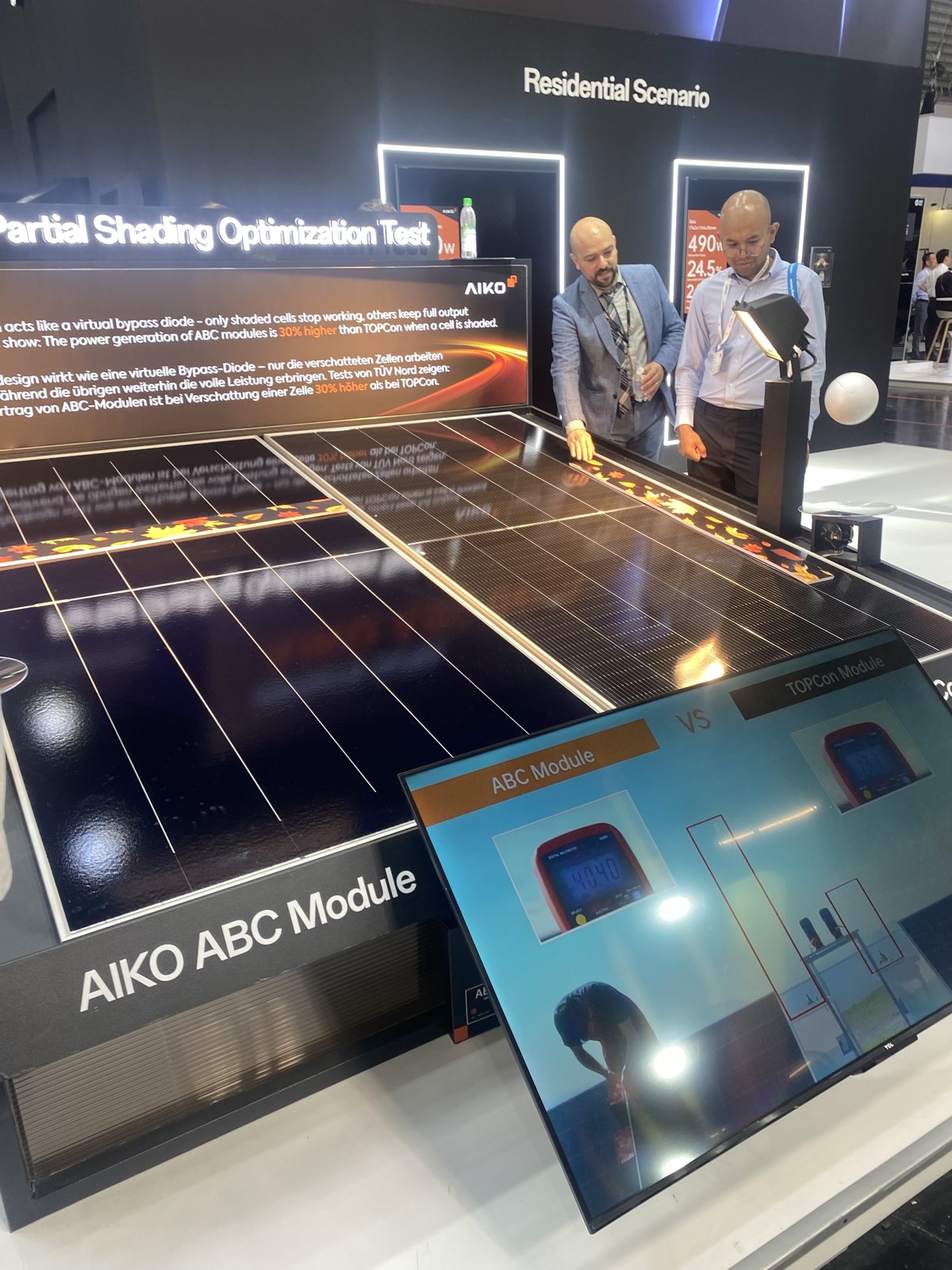
The part that matters for this article is what Aiko calls partial shading optimisation. The ABC cell is built so that a shaded cell stops conducting on its own, without dragging its neighbours into the bypass diode’s territory. Aiko describes it as a virtual bypass diode in every cell: only the shaded cells stop working, the others keep their full output. The stand demonstration was a leaf on one cell of an ABC panel next to a leaf on one cell of a conventional TOPCon panel, with a meter on each, and the gap was obvious from across the aisle. Aiko’s figure, from tests it commissioned at TÜV Nord, is around 30% more output than TOPCon when a single cell is shaded. It is Aiko’s test, so treat the number as theirs, but the behaviour is real and it is what we see on Lancashire roofs with chimneys.
The rest of the case
- More kilowatts from a small roof. A typical UK semi has room for eight to twelve panels. At 24.5% and up, each of those panels does more, which is the difference between a system that covers your evenings and one that does not.
- Heat. Aiko quotes a better temperature coefficient than conventional cells, so output falls less on the warm still days when panels run hottest, and it describes a high temperature restriction in the cell that limits hot spot temperatures under shade.
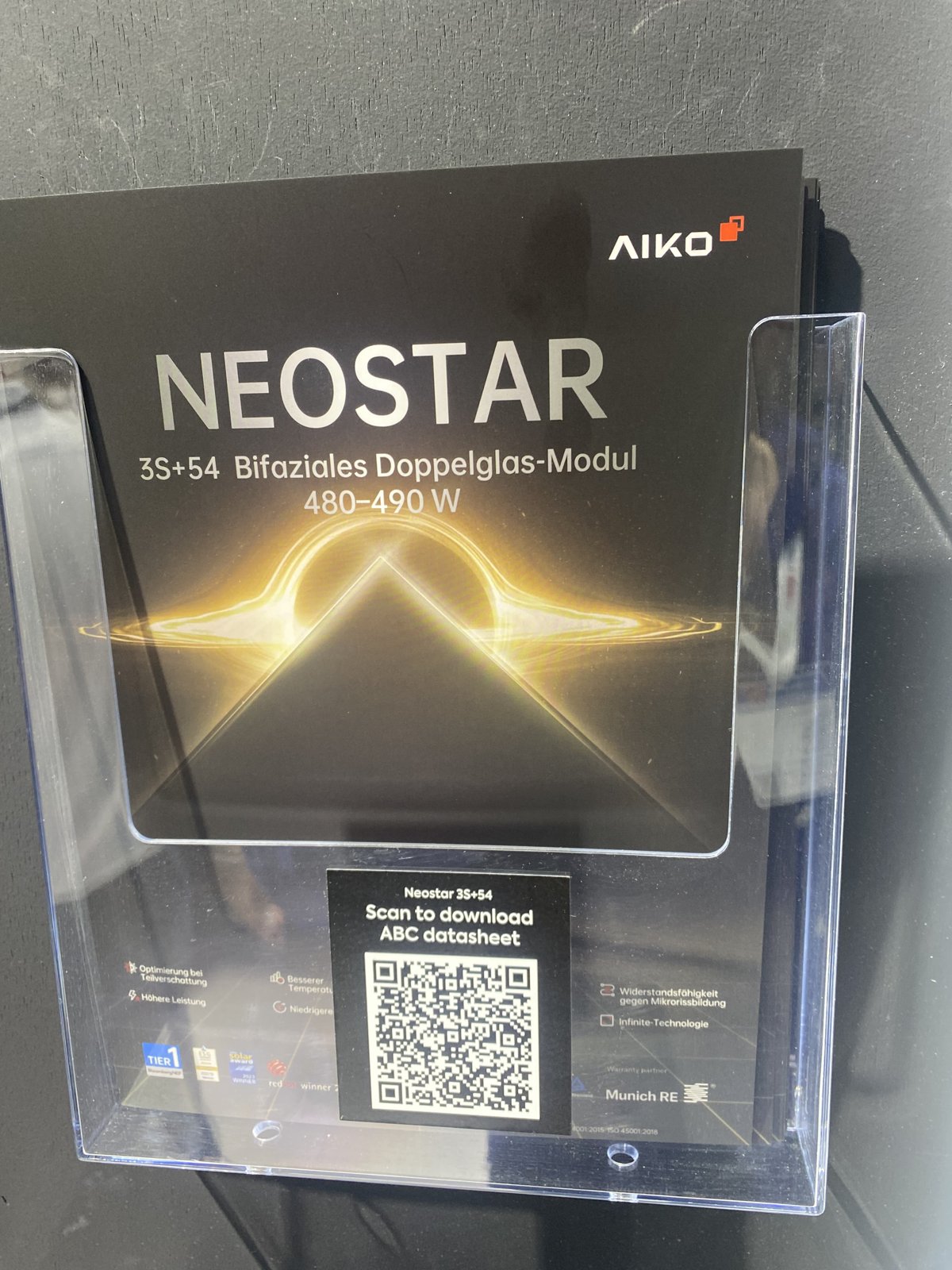
- Toughness. Aiko’s ABC modules hold a Swiss VKF hail certification at the HW4 level from TÜV Rheinland (40 mm hailstones, sixteen impact points, no cracks found by electroluminescence afterwards) and the first TÜV SÜD explosion protection report issued for back contact technology. The stand literature lists Munich Re as warranty partner and a Bloomberg Tier 1 rating.
- Micro cracks. The copper interconnection on the back is less prone to the micro cracking that quietly eats output on soldered front contact cells over the years.
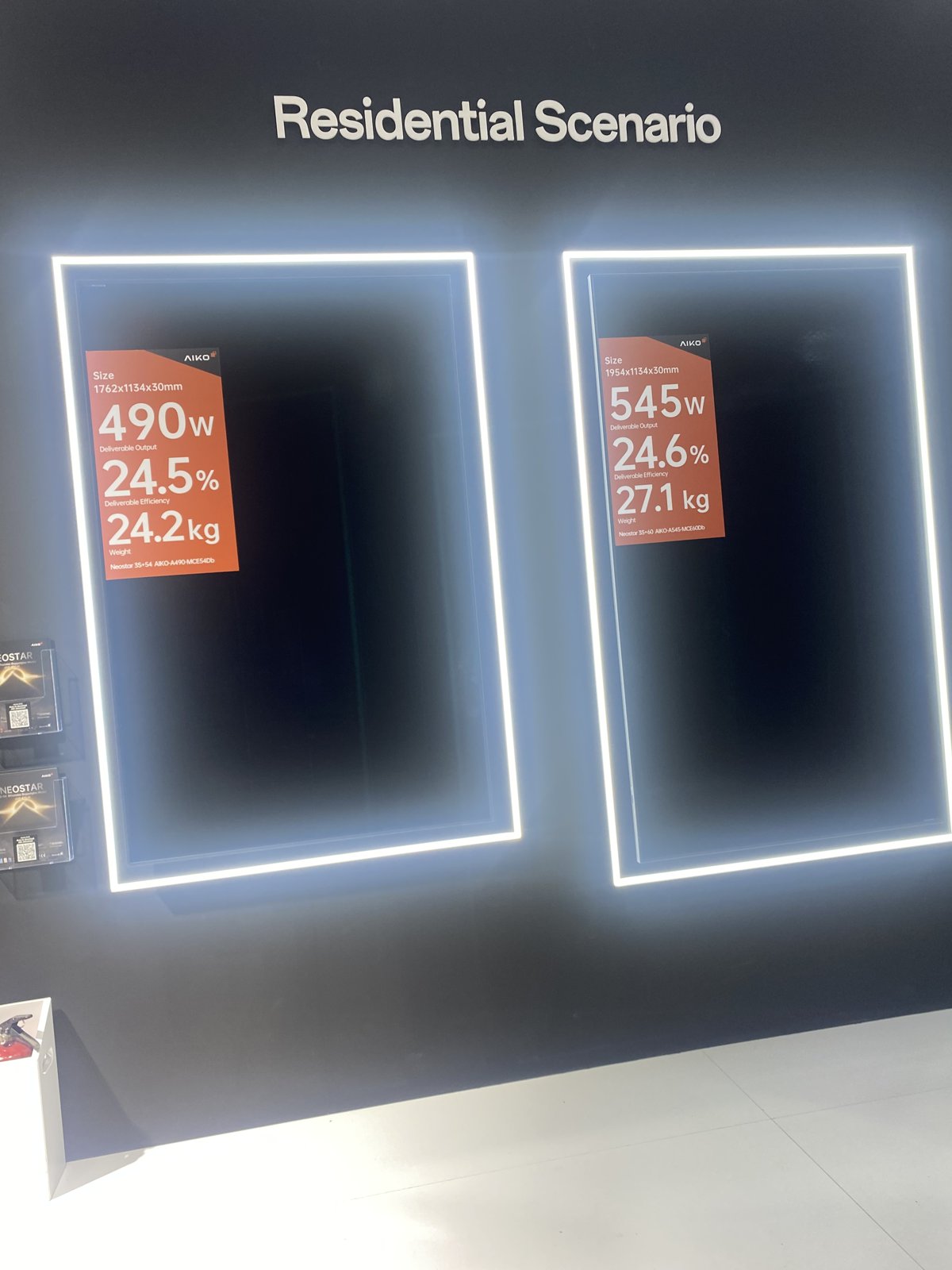
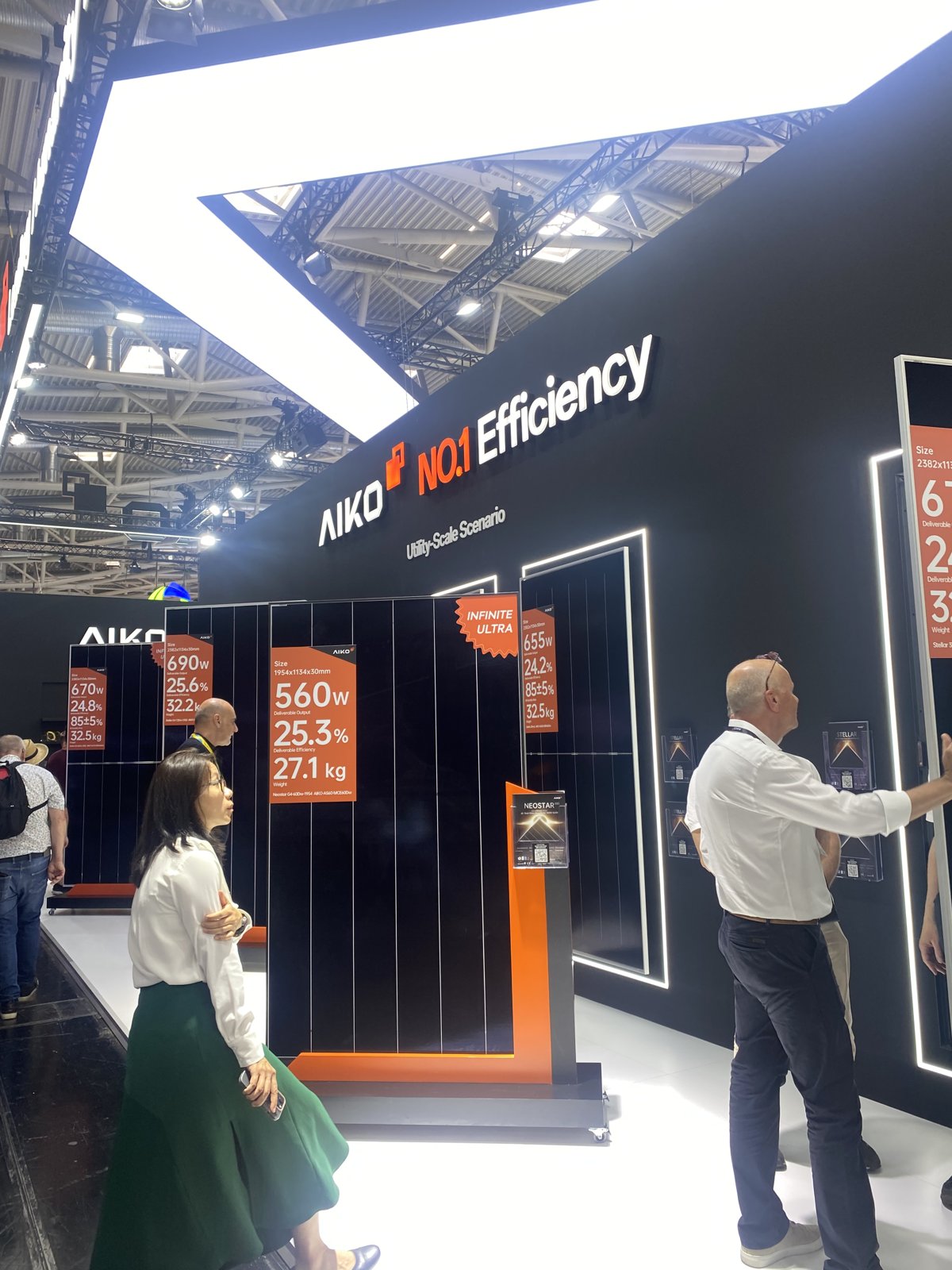
| Module on the stand | Size | Output | Efficiency | Weight |
|---|---|---|---|---|
| Neostar 3S+54 | 1762 x 1134 x 30 mm | 490 W | 24.5% | 24.2 kg |
| Neostar 3S+60 | 1954 x 1134 x 30 mm | 545 W | 24.6% | 27.1 kg |
| Next generation residential (shown as Infinite Ultra) | 1954 x 1134 x 30 mm | 560 W | 25.3% | 27.1 kg |
| Utility scale, largest shown | 2382 x 1134 mm | 690 W | 25.6% | 32.2 kg |
Figures as printed on Aiko’s stand placards in Munich. Deliverable output and efficiency are Aiko’s stated values, not our measurements.
Why Aiko leads on optimisation
There are three places you can deal with shade: at the string, at the panel, or in the cell. A string inverter deals with it at the string, badly, by finding the least worst compromise for every panel at once. An optimiser deals with it at the panel, well, but at a price and with a device to fail. Aiko deals with it in the cell, which is the smallest possible unit and the only place where the fix costs nothing extra to buy, install or maintain. That is the whole argument in one paragraph, and it is why we say Aiko leads on optimisation rather than merely on efficiency.
The two are connected. The back contact design that puts every contact behind the cell is what lifts the placards on the stand to 24.5% and beyond, where mainstream TOPCon modules sit around 22% to 23%. The same design is what lets a shaded cell step aside without taking its neighbours with it. Aiko did not bolt a shading feature onto an efficient panel; the shading behaviour and the efficiency come from the same decision about where the metal goes. Nobody else we install has both in the silicon, and that is what “No.1 Efficiency” on the stand means in practice on a terrace with a chimney every two houses.
What that does to your return
A solar system pays back through kilowatt hours, and every design decision above is a kilowatt hour decision. Four of them show up in the numbers we put in front of you:
- More energy from the same roof. A typical semi has room for eight to twelve panels. At 490 W to 545 W each, rather than the 420 W to 440 W of a mainstream panel of the same size, the array is around 15% bigger without a single extra panel, bracket or hour on site. That is the cheapest 15% you will ever buy.
- Shade losses recovered without buying optimisers. On the chimney and dormer shading we see on most Lancashire roofs, a conventional string gives up anywhere from a few percent to well over ten percent of its annual yield. Cell level optimisation recovers most of that, and you have not paid for a box under every panel to get it.
- Fewer things to go wrong. Every optimiser is a piece of electronics on the roof, in the weather, with its own warranty and its own failure rate. A design that does not need them has fewer components to fail in year twelve, and a smaller call out bill when something does.
- A longer, flatter output curve. Aiko rates its ABC modules for ultra low degradation and better performance at high temperature, and names Munich Re as its warranty partner. Take those as Aiko’s claims, but a panel that loses less each year is a panel that keeps paying in year twenty.
Put together, on the roofs we actually survey, that is the difference between a payback we are comfortable quoting and one we would have to talk around. It is also why our quotes for Aiko systems rarely include optimisers, and why, when they do, we can tell you exactly which panels need them and why.
The look, which matters more than engineers admit
Because there is no metal on the front of an ABC cell, there are no silver busbars, no grid of fine lines and no ribbon running down the panel. What you see from the street is a uniform black surface in a black frame. On a slate roof in the Ribble Valley, or a conservation area in Whalley or Lancaster, that is not a nicety. It is the difference between panels that disappear into the roof and panels that announce themselves, and it is the first thing a planning officer or a neighbour reacts to. We think an all black array is simply better looking, and most of our customers agree once they have seen the two side by side.
Why we chose Aiko, and what we still fit optimisers for
We install three brands and we know all three properly: Tesla for batteries, Fox for inverters and storage, Aiko for panels. Munich was a chance to get our hands on the next generation before it reaches the UK, to put our own questions to Aiko’s engineers rather than to a brochure, and to make sure what we tell customers about shading matches what Aiko can demonstrate with a leaf and a meter. Aiko earned its place on efficiency per square metre, on how its panels behave with the chimneys and dormers that define Lancashire housing, on the all black finish, and on the certification behind the warranty. It did not earn a blanket rule. We still fit optimisers where the four situations above apply, and we still model every roof across the year before we quote, because back contact cells shrink the shading problem, they do not abolish it.
See them for yourself
You do not need a trip to Munich. Solar & Storage Live at the NEC in Birmingham, 22 to 24 September 2026, is the UK show where the brands we install exhibit under one roof, and we go every year. Our preview lists the five things we are going there to check. If you would rather see an all black Aiko array on a real roof, ask us: we have plenty within half an hour of Clitheroe.
Questions we get asked
Do Aiko panels mean I never need optimisers?
No. They handle the common case, a chimney or a dormer clipping one or two panels, without help. Three or more roof directions on one inverter, or heavy moving shade from trees, still call for optimisers or a redesign, and we will tell you which on the survey.
Are optimisers a waste of money on an unshaded roof?
On a single orientation, or two orientations on a two tracker inverter, they add cost and a device per panel for no gain you will see. We do not fit them there.
Is the shading claim independent?
The 30% figure comes from testing Aiko commissioned at TÜV Nord, so it is Aiko’s number. The behaviour behind it, a shaded cell dropping out on its own rather than taking a third of the panel with it, is what we see on real roofs.
Why does the panel look completely black?
All of the electrical contacts are on the back of the cell, so there are no silver lines on the front. Black cells, black frame, no ribbons.
What size system fits a typical semi?
Usually eight to twelve panels. At 490 W to 545 W each that is roughly 4 kW to 6.5 kW, which is why the efficiency matters: the roof is the limit, not the budget.
We survey every roof in person, from our HQ in Clitheroe and our Manchester and London offices, and tell you honestly whether it is worth doing.
Exclusive offers
Solar and battery offers from Energy Giants
The same offers as on our home page, supplied and installed by a competent, compliant workforce.
 Our recommendationSigenergyOne system for solar, battery and EV chargingExplore Sigenergy →
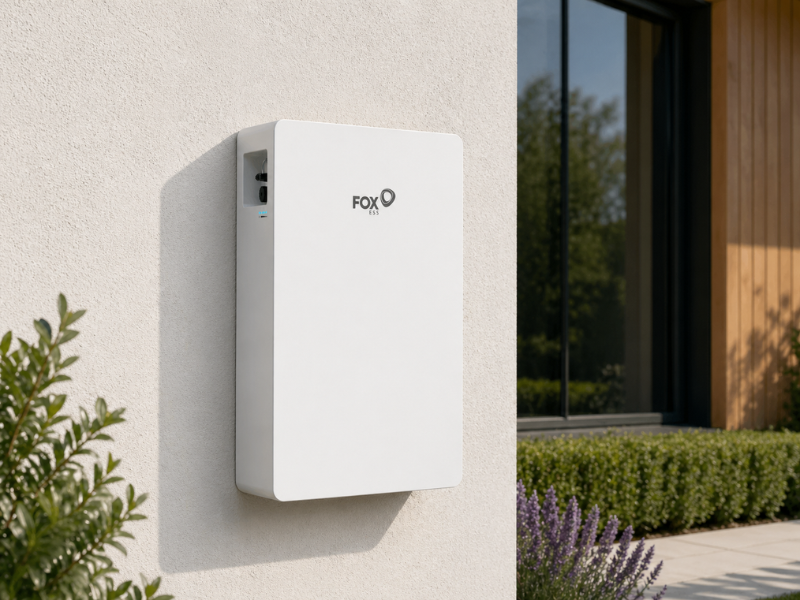 Exclusive bundleFox ESS12 Aiko all-black panels, Fox ESS battery and inverterInstalled from £6,995Get a Fox ESS quote →
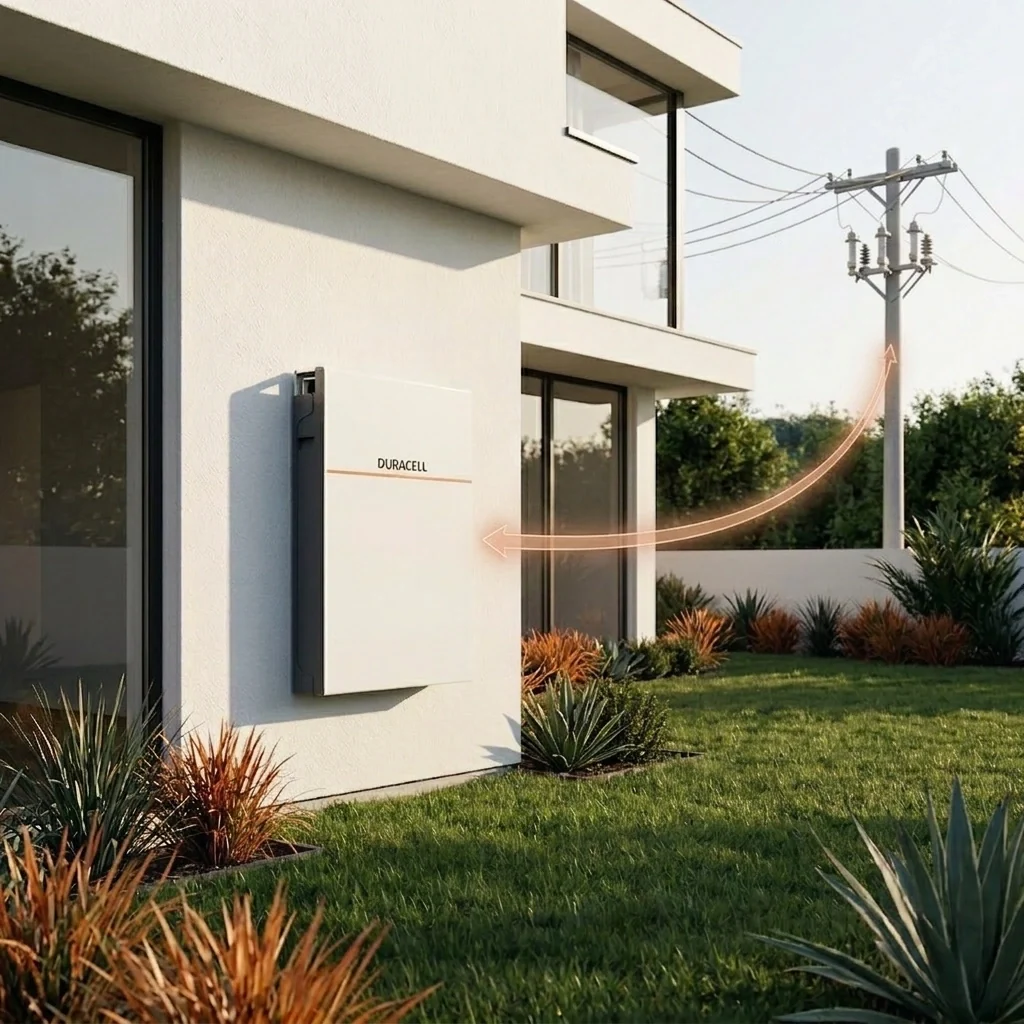 Exclusive bundleDuracell Energy5 all-black 450W panels and a 5kWh batterySupplied and fitted from £6,470Get a Duracell quote →
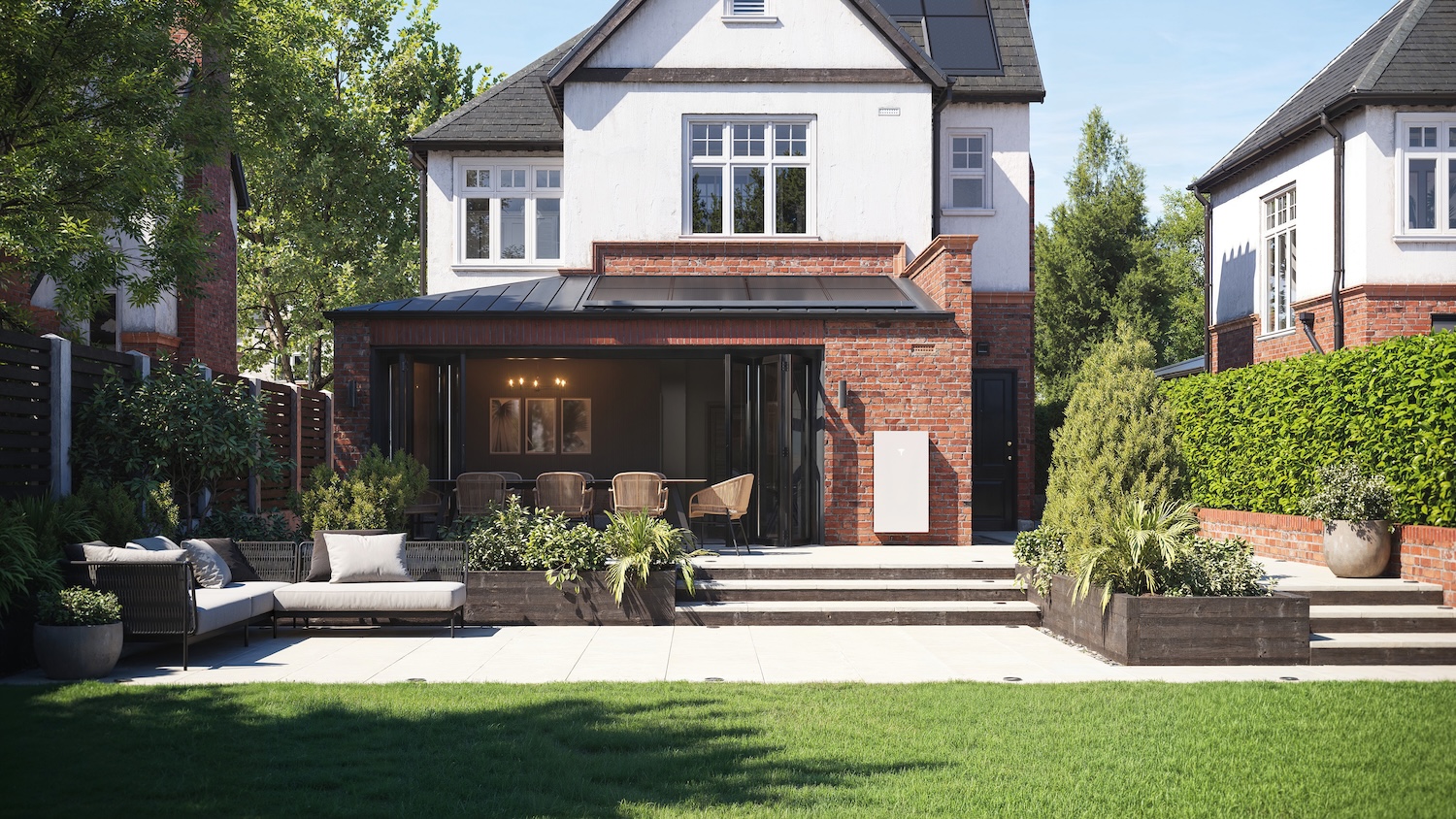 Exclusive offerTeslaPowerwall 3, fully installed with a complete solar systemFrom £6,499Get a Powerwall 3 quote →
All offers are subject to eligibility, survey and availability. See the offers on our home page.
Miles has led retrofit programmes at scale across the UK, with long-standing relationships with local authorities including Kirklees Council, Durham County Council and Ribble Valley Borough Council. He has project-directed programmes for housing associations and delivery partners including Sureserve, LivGreen and BroadOak, and for energy suppliers including E.ON Next, Utilita, British Gas, Octopus and UKEM.