
Every few months a headline announces a solar cell that has smashed a world record. Most of those headlines are about perovskites, and most homeowners who read them ask us the same thing: should I wait? This post explains what perovskites are, who is genuinely ahead, how far the lab is from your roof, and why the panels we fit today are Aiko.
What is a perovskite?
Perovskite is not one material but a family of crystals that share a particular structure, named after the mineral first found in the Ural Mountains in 1839. The versions used in solar cells are made in a lab and can be printed or coated in very thin layers at low temperature, which is why researchers think they could eventually be cheap to make.
Their trick is that they can be tuned. Change the recipe and you change which colours of light the layer absorbs. Silicon, the material in nearly every panel on a British roof, is best at the red end of sunlight. A perovskite can be designed to take the blue end. Put a thin perovskite layer on top of a silicon cell and you get a tandem: two materials sharing the spectrum, each doing the part it is good at.
That matters because silicon on its own has a hard physical ceiling of about 33%, and the best panels are already within sight of the practical limit. Oxford PV, the Oxford University spin-out that has worked on this since 2014, puts the tandem ceiling at 43%. That is the whole reason the industry is so excited.
Who is truly cutting edge?
It depends whether you mean the lab or the roof, and the honest answer is that the two leaderboards are different.
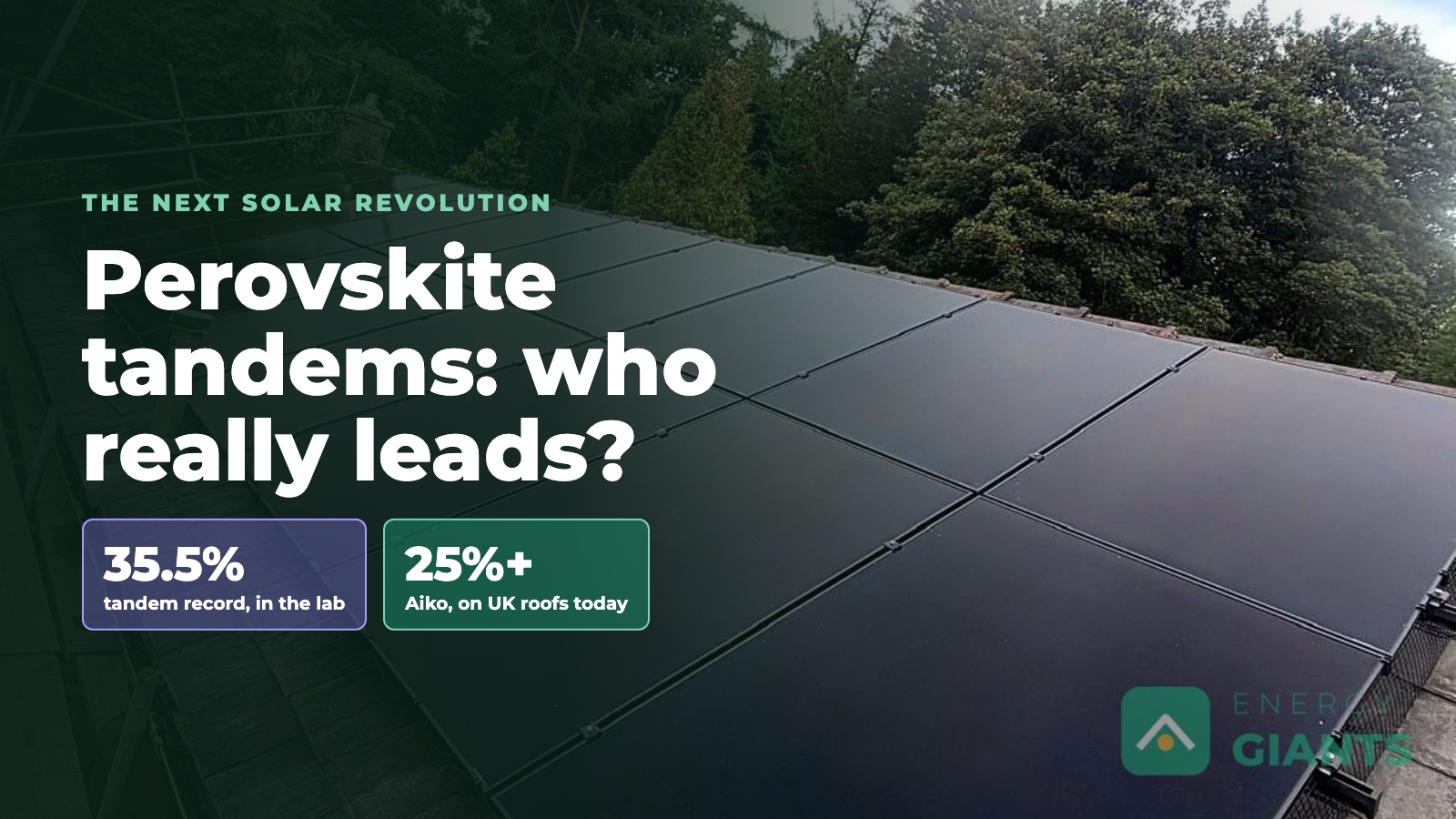
In the lab, LONGi leads. The Chinese giant has broken the tandem record again and again: 33.9% in November 2023, 34.6% in June 2024, 34.85% in April 2025 (certified by the US National Renewable Energy Laboratory) and 35.5% in July 2026, verified by the European Commission's test centre ESTI. JinkoSolar is close behind at 34.82%, notable because it is built on TOPCon, the cell type already filling most factories. But LONGi itself describes its record as a laboratory device and said in June 2026 that it has no active mass-production plan for tandem cells.
In getting tandems out of the door, Oxford PV leads. In September 2024 it made the world's first commercial sale of perovskite-silicon tandem panels, to a US utility-scale project, from its factory in Brandenburg, Germany. Those modules were 24.5% efficient, and the company has reported a 26.9% record module. Its own roadmap targets 27% by 2027, 30% by 2030 and 35% by 2035, with a warranty of 10 years or more on current products.
On the roof today, Aiko leads. Its All Back Contact (ABC) silicon panels are rated above 25% efficiency, and it showed a 25.2% record module at Intersolar in 2024. Independent rankings this year put Aiko first for residential efficiency, ahead of Recom (24.8%) and LONGi's own back-contact Hi-MO X10 (24.3%).
| Maker | Technology | Best published efficiency | Where it is |
|---|---|---|---|
| Aiko | All Back Contact (ABC) silicon | 25%+ module; 25.2% record module shown 2024 | On UK roofs now |
| Recom | Back-contact silicon (Black Tiger) | 24.8% module | On UK roofs now |
| LONGi | HPBC 2.0 back-contact silicon (Hi-MO X10) | 24.3% module | On UK roofs now |
| LONGi | Perovskite on silicon tandem | 35.5% cell (lab); 31.4% small tandem module | Lab record |
| JinkoSolar | Perovskite on TOPCon tandem | 34.82% cell (lab) | Lab record |
| Oxford PV | Perovskite on silicon tandem | 24.5% shipped modules; 26.9% record module | Utility pilots |
Cell and module figures are not like for like: a cell is a few square centimetres in a lab, a module is a full panel with frame, glass and wiring losses. Figures as published by the makers and the trade press listed at the end, October 2026.
We model your roof, your shading and your real usage, then tell you plainly what the system will produce and when it pays back.
Why perovskites are not on your roof yet
Three problems stand between the record and a house in Lancashire.
Durability. Silicon panels routinely carry 25 to 30 year performance warranties because we have decades of field data. Perovskites can degrade with heat, moisture and light, and the BBC's October 2025 report on the material noted that everything hinges on how they hold up outdoors. Oxford PV's warranty of 10 years or more is a real step, but it is not yet a 30 year promise.
Scale. Record cells are tiny. When LONGi scaled a tandem up to a full-size 261 cm² wafer the figure fell to about 33 to 34%, and its small tandem modules came in at 29.4 to 31.4%. Large-area coating, factory yield and encapsulation are all still being worked out.
Lead. Most high-performing perovskites contain a small amount of lead. It is sealed inside the panel, but end-of-life handling and recycling rules will need to be clear before these products are sold widely for homes.
None of this means the technology will not arrive. It means the first tandem panels are going to utility solar farms, where a developer can monitor and swap modules, before they reach domestic roofs with long, consumer-facing guarantees.
Should you wait for perovskite panels?
For most households, no. A panel that is not yet sold for UK homes saves nothing on your bill, while a system fitted now starts earning from the first sunny day. The gap is also smaller than the headlines suggest: Oxford PV's shipped tandem modules were 24.5% efficient, and the Aiko panels we install today are already above 25%. Roof space, orientation, shading and a sensible battery decision move your savings far more than a couple of percentage points of efficiency.
When tandem panels do reach the domestic market with proper warranties and UK certification, we will tell you, and we will fit them if they are the better buy.
What it means for UK rooftops: cost, yield and return
Efficiency does not make each kilowatt cheaper. What it changes is how much power you can fit on the roof you have. Most British roofs run out of space before the budget runs out, especially terraces, semis with a dormer or a valley, and stone cottages with chimneys. Take 20 m² of usable south facing roof, about the size of one side of a typical semi:
| On 20 m² of roof | System size | Yield a year | Value a year | Indicative cost | Simple payback |
|---|---|---|---|---|---|
| Standard panel, 21.5% | 4.3 kWp | 3,655 kWh | about £648 | about £7,297 | about 11 years |
| Aiko ABC, 25% | 5.0 kWp | 4,250 kWh | about £753 | about £8,485 | about 11 years |
| Tandem, 30% (future) | 6.0 kWp | 5,100 kWh | about £904 | Not sold for UK homes | Unknown |
Illustrative, not a quote. 850 kWh a year per kWp (south facing roof in Lancashire, standard calculation method); 40% of generation used in the home at 26.32p (Ofgem cap, October to December 2026) and 60% exported at 12p; first year, flat prices, panels only. Cost at the DESNZ 2025/26 median of £1,697 per kW for 4 to 10 kW systems, VAT included where charged; 0% VAT on solar until 31 March 2027. The tandem row uses Oxford PV's 2030 module target and is hypothetical.
Three things stand out. First, a 25% Aiko array on that roof makes roughly 600 kWh a year more than a standard panel, worth about £105 a year at today's prices, or around £2,600 over 25 years before degradation. Second, the payback is about the same, near eleven years panels only, because you are buying more system, not cheaper system; the Energy Saving Trust puts panel only payback at roughly eleven to twenty one years. Add a battery and more of the power is used at home instead of sold at 12p, which is where payback shortens (see our solar panel cost guide for real ranges). Third, a future 30% tandem would add another 850 kWh or so from the same roof, but nobody can price it for a UK home yet, and its warranty would need to match silicon's before the numbers stack up.
UK weather tips the balance further. Back contact panels like Aiko's are designed to keep producing when part of the panel is shaded, and British roofs have plenty of chimneys, dormers and trees. Their low temperature coefficient matters less here than in Spain, but their low degradation matters more: our payback runs over a decade, so the panel needs to be producing strongly in year twenty.
Why we choose Aiko
 The panel brand we fit as standard on Energy Giants solar installs.
We have no reason to be loyal to a brand; we have every reason to be loyal to the result on your roof. Aiko wins that test for us today on five counts.
- Efficiency you can actually buy. Above 25% at module level, the highest of any panel we can source for UK homes. More watts per square metre matters on terraces, dormers and small or awkward roofs.
- Nothing on the front. All the wiring sits on the back of each cell, so there are no silver busbars shading the surface. That is more light reaching silicon and a clean all-black look that suits slate and stone roofs.
- Better in partial shade. The ABC design is built to limit losses when part of a panel is shaded by a chimney, tree or dormer, and Aiko's testing found hot-spot temperatures more than 30% lower than comparable TOPCon panels. Cooler hot spots mean less stress on the panel over its life.
- Holds up in heat. A temperature coefficient of -0.26% per degree, against about -0.29% for a typical panel, so less output is lost on hot summer afternoons.
- Built to last. Rated degradation of 1% in year one and 0.35% a year after that, which leaves roughly 90% of the original output after 30 years, backed by a 30 year performance warranty.
You can see Aiko panels at work in our case studies, including a 9.72 kWp Aiko array paired with a Tesla Powerwall 3 in Aberystwyth. We are MCS certified for solar PV and battery storage, so every system is designed, installed and registered to the scheme.
A free survey, a straight answer on output and payback, and Aiko panels sized to your roof and your usage.
- Oxford PV, Technology (efficiency roadmap, 43% ceiling, warranty)
- BBC Future, Perovskite: the wonder material that could transform solar energy, October 2025
- PV Tech, Oxford PV ships first commercial perovskite tandem modules
- LONGi, 34.85% tandem record (NREL)
- pv magazine, LONGi 35.5% tandem cell, July 2026
- LONGi, 35.5% record and module results
- pv magazine, Aiko 545 W back-contact module, March 2026
- pv magazine, Aiko 25.2% record module, June 2024
- Clean Energy Reviews, Most efficient solar panels 2026
Miles has spent two decades in retrofit and has worked at scale across the UK, with long-standing relationships with local authorities including Kirklees Council, Durham County Council and Ribble Valley Borough Council. He has project-directed programmes for housing associations and delivery partners including Aspire Housing, Sureserve, LivGreen and BroadOak, and for energy suppliers including E.ON Next, Utilita, British Gas, Octopus and UKEM.