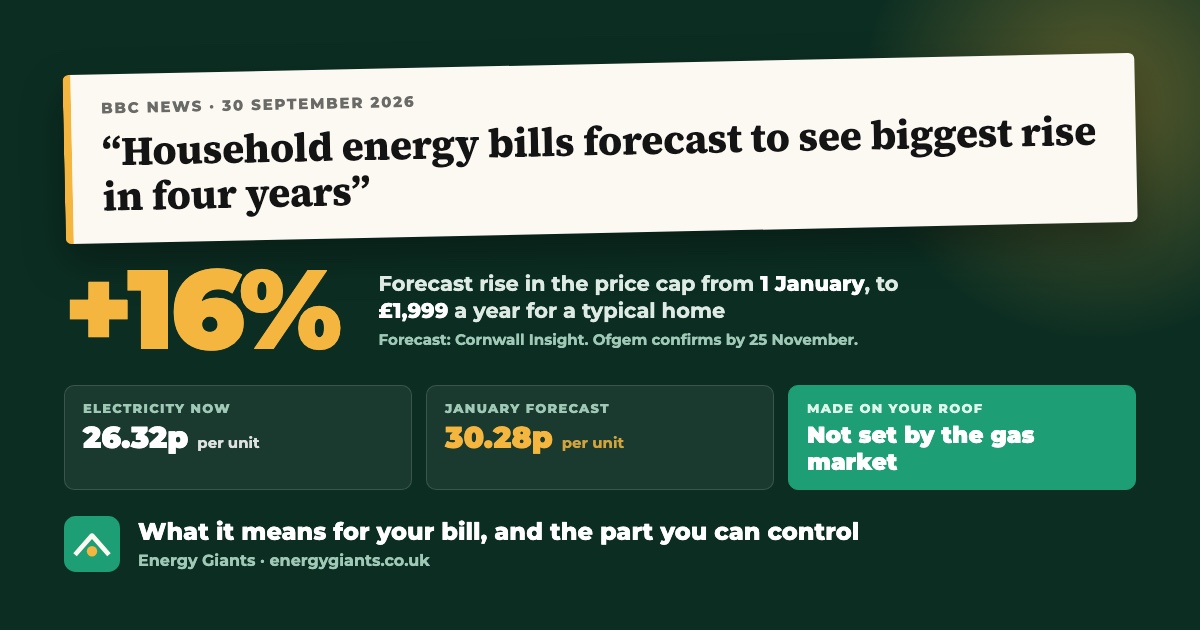

Household energy bills are forecast to rise by 16 per cent in January, the biggest jump in four years. That would take a typical bill to £1,999 a year, landing in the coldest, most expensive month of the winter.
The forecast comes from Cornwall Insight, the consultancy whose price cap predictions are widely followed across the industry, and was reported by the BBC this morning. It arrives a day before the October price cap takes effect, which already puts bills up by 4 per cent from tomorrow, 1 October.
It is a forecast, not a decision. Ofgem announces the January cap by 25 November. But Cornwall Insight describes a January rise as "all but certain", because Ofgem sets the cap using wholesale prices from a fixed observation window, and that window is already about halfway through.
What it means for your bill
For a typical home on a standard variable tariff, the January forecast works out at about £23 a month more than the October cap. The unit price of electricity would go from 26.32p to around 30.28p.
| National average, direct debit | 1 Oct to 31 Dec | January forecast | Change |
|---|---|---|---|
| Electricity, per unit | 26.32p | 30.28p | +15% |
| Gas, per unit | 7.97p | 9.76p | +22% |
| Typical bill, a year | £1,723 | £1,999 | +£276 |
| Typical bill, a month | about £144 | about £167 | about +£23 |
October unit rates from Ofgem. January unit rates and totals from Cornwall Insight's Default Tariff Cap forecast, as published. Monthly figures are the annual totals divided by twelve. Electricity carries no VAT from 1 October 2026 to 31 March 2027. What you pay depends on your usage, region and meter.
If you are on a fixed tariff, the price cap does not set your rates until your deal ends. If you are on a standard variable tariff, which is where about 20 million households in England, Scotland and Wales are, it does.
Why prices are going up again
According to Cornwall Insight, the main driver is the conflict in the Middle East disrupting gas supplies, and three things are keeping the pressure on:
None of that is anything a household can influence. What you can influence is how much of your electricity you have to buy at whatever the cap says.
We survey every roof in person and tell you honestly whether solar or a battery is worth it for your home. No obligation, and no pushy follow-up.
The part of your bill you can control
A unit of electricity your own panels make, and you use in the house, is a unit you never buy from your supplier. It is not priced off the gas market, and it is not affected by what Ofgem announces in November. The higher the unit rate goes, the more each of those units is worth to you.
Simple arithmetic: 1,000 kWh at 26.32p and at 30.28p a unit. How many units your own panels replace in a year depends on your roof, your system and when you use electricity, which is what a survey works out. It is not a prediction of your savings.
A home battery adds to that. It stores what your panels make during the day for the evening, when most families use the most electricity. It can also charge overnight on a cheaper time of use tariff, where your supplier offers one, and run the house from that stored energy at teatime.
Nine panels (4.37 kWp) and an 11.52 kWh battery, fitted in July 2026. The design estimates a saving of about £840 in the first year at today's prices, and payback in about ten years, for a system that costs between £8,000 and £9,000 installed.
Those figures come from the system design at current unit and export rates. They are an estimate, not a guarantee, and a different house will give different numbers.
Read the Somerset Avenue case study →The honest bit about January
We would rather you heard this from us. Solar panels make far less electricity in December and January than in summer. In mid winter they chip in rather than cover the house. The case for solar rests on the whole year, and on the next 25 years, not on one cold month.
In winter, a battery tends to do more of the work than the panels. Charged on a cheaper overnight rate and used at the evening peak, it can cut the cost of the units you do still buy. Whether that pays for your home depends on the tariffs available to you and how you use electricity, so we look at it at the survey.
Do these first
We install solar and batteries for a living, so weigh that. Before you spend money on anything, these are worth doing:
- If you are struggling to pay, tell your supplier now. Ofgem says suppliers must help if you ask, for example with a repayment plan or emergency credit. Citizens Advice can help too.
- Check whether a fixed tariff suits you. That is a conversation for a comparison service or your supplier, not an installer.
- Cut what you use. Loft and cavity wall insulation are among the cheapest ways to reduce your heating bill, and you may qualify for help through Warm Homes grants.
- Then look at generating and storing your own. That is where we come in, with a survey that tells you straight whether it is worth it.
Questions we are being asked
When will the January price cap be confirmed?
Ofgem announces the cap for 1 January to 31 March 2027 by 25 November 2026. Until then, £1,999 is Cornwall Insight's forecast, not a confirmed figure.
Does the price cap rise affect me if I am on a fixed tariff?
Not while your fix lasts. The cap sets the maximum rates on standard variable tariffs. When a fixed deal ends you move onto a variable tariff unless you choose another fix.
Will solar panels help with my bills in January?
A little. Output in mid winter is low, so panels contribute rather than cover your usage. Most of the value comes from spring to autumn, which is why we look at the whole year when we design a system.
Is a battery worth it without solar panels?
It can be. A battery on its own can charge on a cheaper overnight tariff and power the house in the evening. Whether it pays depends on the tariffs you can get and when you use electricity, so we work it out for your home rather than quote an average.
How much could I save?
It depends on your roof, your usage and when you are at home. One of our installs, in Wilpshire, is estimated at about £840 in its first year at today's prices. Your figure could be higher or lower, and the survey gives you an estimate for your own house.
Energy Giants is now MCS certified for solar PV and battery storage, and a TrustMark registered business. We survey in person, show you the numbers for your home, and tell you if it is not worth doing.
Sources
- BBC News: Household energy bills forecast to see biggest rise in four years, 30 September 2026
- Cornwall Insight: 16% price cap rise forecast in January, 30 September 2026
- Ofgem: Changes to energy price cap between 1 October and 31 December 2026, 26 August 2026
Figures are national averages for a typical dual fuel household paying by direct debit, using Ofgem's typical consumption values of 2,500 kWh of electricity and 9,500 kWh of gas a year. The January figures are a forecast and are not a confirmed cap. The price cap limits unit rates and standing charges, not total bills. We are an installer, not an energy supplier or a comparison service, and nothing here is financial advice. Savings figures for our installs are estimates at today's prices, not guarantees.
Miles has spent two decades in retrofit and has worked at scale across the UK, with long-standing relationships with local authorities including Kirklees Council, Durham County Council and Ribble Valley Borough Council. He has project-directed programmes for housing associations and delivery partners including Aspire Housing, Sureserve, LivGreen and BroadOak, and for energy suppliers including E.ON Next, Utilita, British Gas, Octopus and UKEM.